Medly Uganda is a mobile health (mHealth) project that is a joint collaboration between UINCD, Yale University (CT, USA), and University Health Network (Toronto, Canada). Medly Uganda builds upon the experience and expertise of UHN’s Centre for Digital Therapeutics (formerly Centre for Global eHealth Innovation) in designing and implementing Medly, a self-care application for patients with heart failure.
Medly Uganda leverages a Government of Uganda-owned and -operated mHealth platform called FamilyConnect which uses technologies (USSD and SMS) available on all types of mobile phones to provide self-care education for pregnant and postpartum women. In 2018, Uganda Ministry of Health authorized UINCD to develop and integrate NCD modules into the FamilyConnect platform. The process of adapting Medly to the Ugandan context involved extensive stakeholder engagement and mixed methods research with a focus on user-centered and service design. Medly Uganda uses patient symptom reporting to triage patients’ level of symptom severity, provide relevant self-care information, connect them with a clinician, and make treatment recommendations. We developed a clinician-facing dashboard that automatically integrates the reported symptoms and system output with clinician documentation to enhance longitudinal care. Our pilot clinical trial, “An accessible, scalable, patient-facing mHealth application for self-care of heart failure in LMIC” was funded by the National Institutes of Health (clinicaltrials.gov: NCT04426630) and was implemented at the Uganda Heart Institute. We continue to work on further contextual adaptations of Medly Uganda with a focus on improving equitable access and to explore applications for this promising tool in other chronic conditions, including mental health conditions
This body of work was started by Dr. Martin Muddu when he was a Global Health Equity Scholar under the mentorship of UINCD co-directors Dr. Ssinabulya and Schwartz. Dr. Muddu began by describing, for the first time, an integrated HIV-hypertension (HTN) care cascade and demonstrated shortcomings of HTN care within a high-functioning HIV programme in Eastern Uganda. He then applied that cascade and lessons learned to a mixed methods study at the Makerere Joint AIDS Program, the largest HIV clinic in Uganda, serving over 16,000 persons living with HIV and then implemented an integrated care strategy there and demonstrated outstanding patient outcomes. Building on this work, Drs. Muddu, Ssinabulya, and Schwartz are currently participating in PULESA-Uganda, a 5-year, NIH-funded implementation study of HIV and HTN in Kampala and Wakiso Districts. PULESA is one of six projects in the HLB-SIMPLe Consortium.
Syndemic-Adapted Medly Uganda (SAMU) is a formative digital health initiative that adapts the Medly Uganda platform to support integrated detection, linkage to care, and ongoing management of depression, anxiety, and alcohol use disorder among people living with HIV and hypertension in Uganda. Using a human-centered design approach, SAMU actively engages patients, caregivers, and healthcare workers to co-design culturally appropriate, technology-enabled tools for symptom screening, self-management, and provider decision support. The project aligns with national priorities for integrated chronic care and aims to strengthen equitable, scalable mental health service delivery within existing HIV and non-communicable disease care platforms.
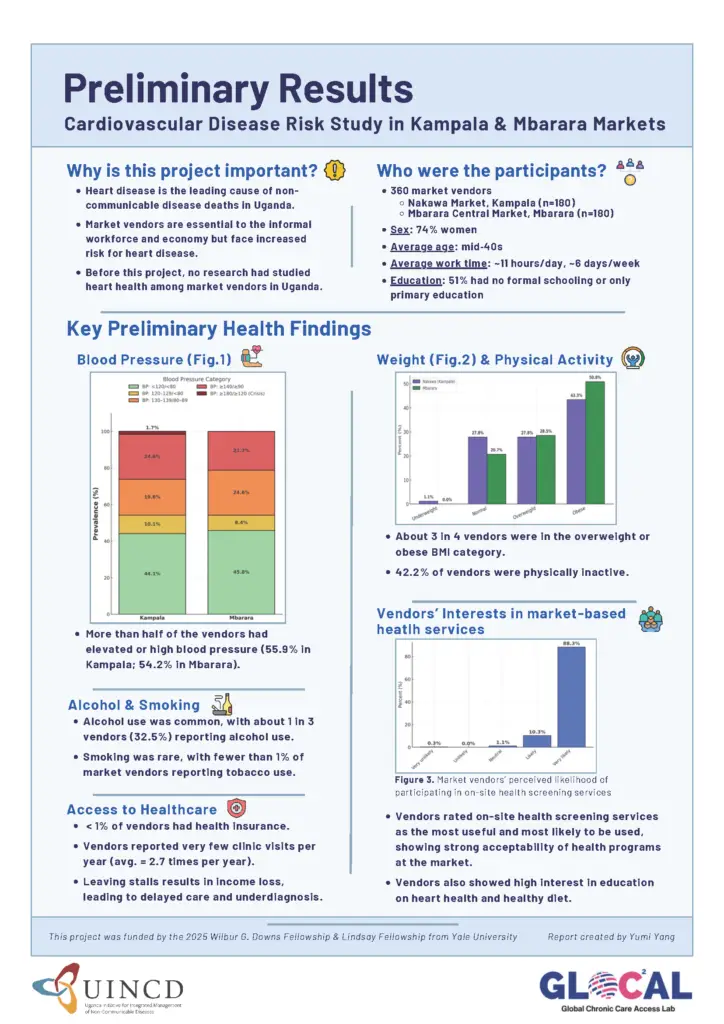
MARKET CVD Risk Study is a cross-sectional research project conducted among 360 urban market vendors in Kampala and Mbarara Markets, in partnership with Yale University, Development Initiatives International (DII), and UINCD. As the first study to examine cardiovascular disease (CVD) risk and healthcare barriers among market vendors in Uganda, preliminary findings indicate a substantial burden of CVD risk factors, with more than half of vendors having elevated or high blood pressure (55.9% in Kampala; 54.2% in Mbarara), approximately 3 in 4 being classified in the overweight or obese BMI categories, and 42.2% reporting to be physically inactive. Vendors also face significant barriers to care, including limited access to routine healthcare services and income loss when leaving market stalls, while expressing strong interest in on-site health screening and prevention services. This study provides novel formative quantitative data on a vulnerable population at high risk for CVD and explores opportunities to co-create implementation strategies with vendors and stakeholders. Ongoing analyses and community engagement will continue to inform feasible, market-level interventions aligned with daily routines and structural constraints in Ugandan markets.
Preliminary Results For Market leadership CVD Risk Study
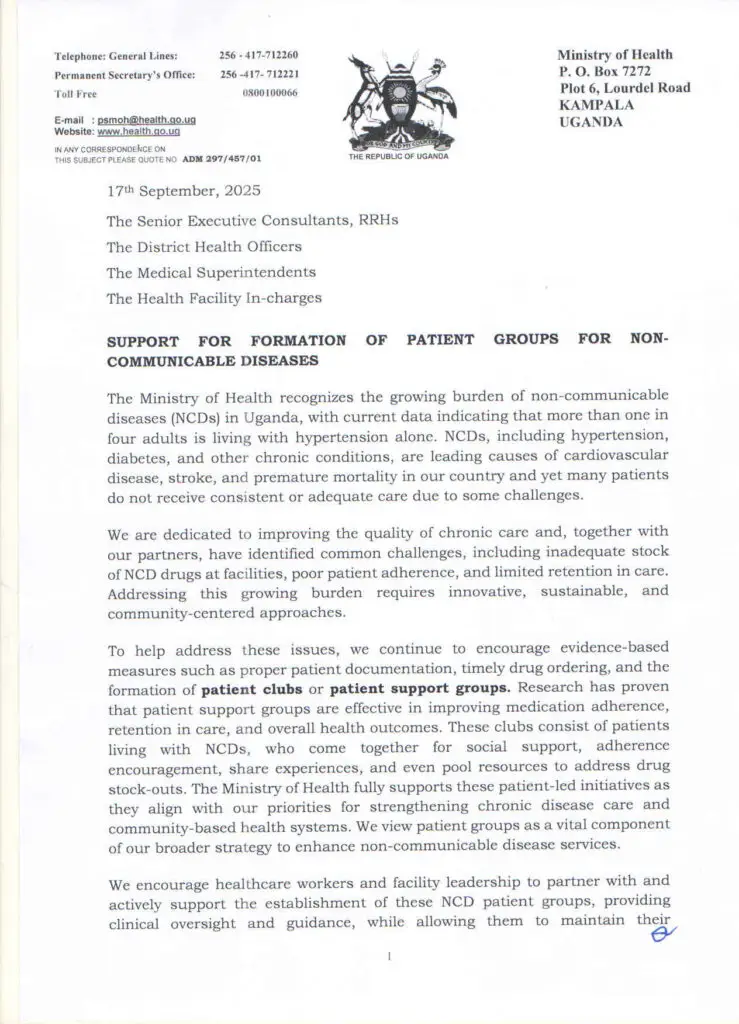
In Uganda, patients, especially those with hypertension and diabetes mellitus, have organised themselves into peer-led support groups that pool money mainly to buy medicines due to frequent stock-outs at public health facilities. These groups exist across different levels of public health facilities in Uganda, with leadership structures, and some are registered formally as community-based organisations with the local district authorities. Working with healthcare workers as stewards, patient-led committees buy medicines collectively in bulk from wholesalers or suppliers, at lower prices than they would buy individually. Patients describe this approach as a practical response to medicine shortages.
The Ministry of Health has also issued memos encouraging patients to organise themselves into these groups to complement the public procurement system. Beyond medicine purchasing, the groups also provide opportunities for patients to share experiences, encourage one another and learn about managing their conditions. At UINCD, we are investigating how these fund-pooling patient support groups operate, the challenges they face and the factors that sustain them. This research will inform practical strategies to strengthen these groups, scale them up, and support their formal integration into the primary health care system

We are developing additional research areas and will update this page accordingly.
For a complete list of our research publications click here
© 2026 UINCD